The Art of Spatial Navigation: Mapping Your Way to a Sharper Brain
Discover how the simple, everyday act of navigating your world without a GPS can strengthen your hippocampus and keep your cognitive map robust as you age.
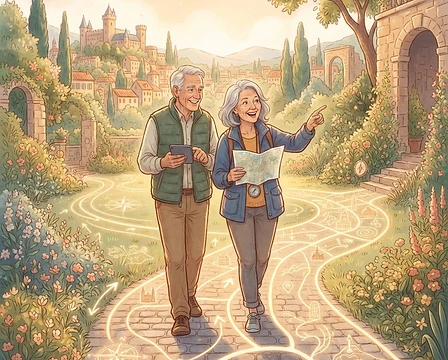
Rediscovering the Joy of the Wayfinder
In our modern world, we have become remarkably good at following the blue line on our smartphone screens. Whether we are heading to a new doctor’s office, a friend’s house, or a local park, our devices guide us with turn-by-turn precision. While this technology is undeniably convenient, it comes with a subtle, unintended cost: our brains are taking a vacation from one of their most essential jobs—spatial navigation.
For those of us over 50, maintaining the ability to mentally map our surroundings is a powerful form of cognitive fitness. Research suggests that when we actively navigate—relying on landmarks, distance estimation, and mental imagery—we engage the hippocampus, the part of the brain responsible for memory formation and spatial awareness. By intentionally stepping away from the GPS occasionally, we can turn a routine trip into a brain-boosting workout that strengthens our neural pathways.
The Neuroscience of Your Inner Map
Think of your brain like a muscle. When you use a GPS, the device does the heavy lifting. You are essentially a passenger, even if you are the one driving. However, when you navigate by memory or by reading the environment, your brain must constantly process information. It asks questions: Is that the red barn I saw last time? Did I pass that intersection three blocks ago? How does this street connect to the main highway?
This process is known as forming a "cognitive map." As you build these internal representations, you are actively creating new connections between neurons. Studies have shown that people with well-developed spatial navigation skills tend to have larger, more active hippocampal regions. In the context of healthy aging, keeping this "GPS-free" skill sharp is a fantastic way to maintain independence, confidence, and overall mental sharpness. It’s not about never using technology again; it’s about choosing moments to engage your natural internal compass.
Start Small: Navigating Your Immediate Environment
You don’t need to drive across the state to start training your spatial awareness. In fact, the best training ground is often the neighborhood you already know. The goal is to move from "automatic pilot" to "active observer."
Here are a few concrete ways to start practicing:
- The Landmark Method: The next time you walk or drive to a familiar location, turn off the digital assistance. Instead of focusing on street names, focus on landmarks. Identify unique structures, colorful trees, or specific corners. Try to articulate them out loud: "I turn left at the house with the blue door." This forces your brain to encode visual information into memory.
- The Return Trip Challenge: If you are visiting a place that is slightly out of your comfort zone, use your GPS to get there, but challenge yourself to find your way back home without it. You will naturally pay more attention to the route on your way out if you know you are responsible for the return journey.
- Mental Walkthroughs: When you get home, spend two minutes with a cup of tea, visualizing the route you just took. Re-trace the turns in your mind. This is a form of cognitive rehearsal that cements the spatial information, effectively "mapping" the area into your long-term memory.
Expanding the Horizon: Beyond the Familiar
Once you feel comfortable navigating your local area, look for opportunities to challenge your brain in new environments. Spatial navigation is most beneficial when the challenge is fresh.
Consider these playful strategies:
- The Scenic Detour: Choose a day when you aren't in a rush. Take a "wrong turn" on purpose in a safe, familiar area and see if you can find your way back to a main road using only your sense of direction. This transforms a potentially stressful event into a fun, low-stakes problem-solving game.
- Pedestrian Mapping: Walking is perhaps the best way to develop a cognitive map because you are moving at a speed that allows your brain to truly absorb the environment. Visit a nearby town center or a large park and walk without a map. Focus on the relationship between different points: "The café is behind the library, which is south of the fountain."
- Active Observation: When you are a passenger in a car, don't zone out. Practice estimating how long it takes to get from Point A to Point B, or guess which direction North is. By staying engaged with your surroundings, you prevent the cognitive "numbness" that often accompanies passive travel.
Closing Thoughts on Staying Oriented
Embracing the role of a wayfinder isn't just about knowing how to get from point to point; it is about staying engaged with the physical world around you. By training your brain to build maps, recall landmarks, and visualize routes, you are investing in the long-term health of your hippocampus and your overall cognitive vitality. Start with a short walk tomorrow—leave the phone in your pocket, look up at the horizon, and let your brain show you the way.
Note: This article provides general information and is not a substitute for professional medical advice, diagnosis, or treatment. Always seek the advice of your physician or other qualified health provider with any questions you may have regarding a medical condition.
Are you ready to keep your mind as active as your body? At Mentally Fresh, we believe that consistent, fun practice is the key to lasting cognitive health. We invite you to join our community of learners and brain-fitness enthusiasts. Sign up for our daily memory games, puzzles, and specialized challenges by visiting us at /register today!
Keep your mind sharp every day
Daily games and nostalgic stories, made for adults 50+.